
Clonezilla
Clonezilla is a free, open-source partition and disk imaging and cloning program for system deployment, bare-metal backup and recovery.
Operating system: Windows
Publisher: Steven Shiau
Release: Clonezilla 3.3.3
Antivirus check: VirusTotal report
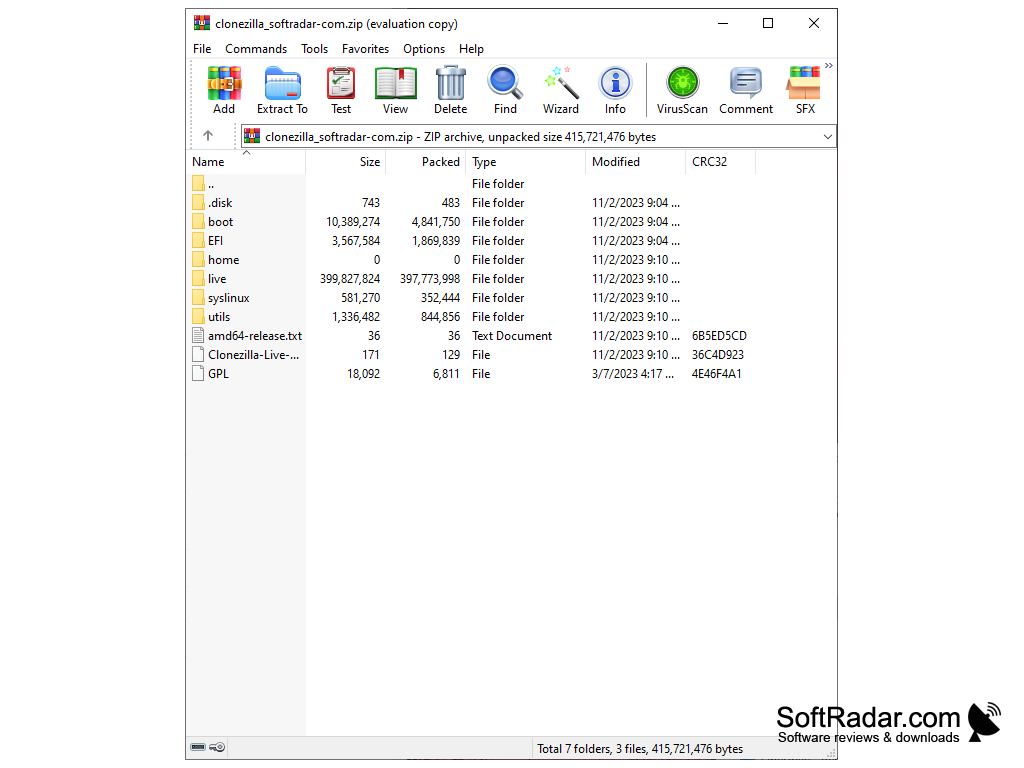
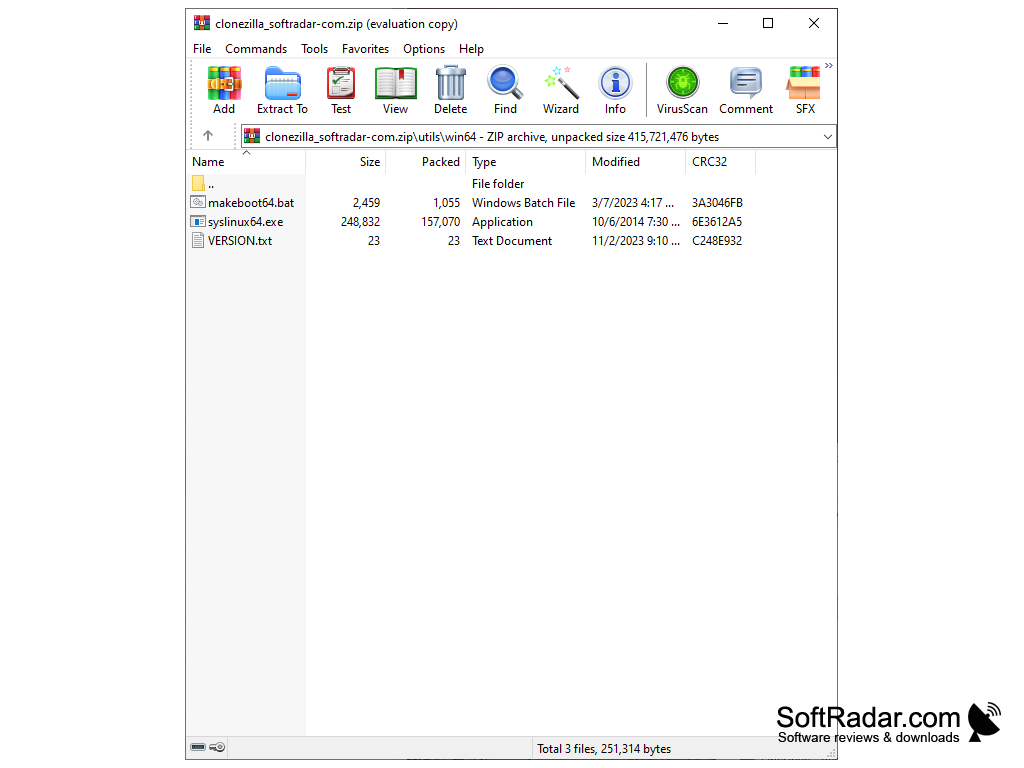
Clonezilla is a partition and disk imaging and cloning program. It helps to do system deployment, bare metal backup, and recovery. It is very similar to True Image or Norton Ghost.
There are three types of Clonezilla available:
1. Clonezilla Live - It is suitable for single machine backup and restore.
2. Clonezilla Lite Server - It is designed for massive deployment from an image via multicast or BitTorrent.
3. Clonezilla SE (Server Edition) - It is included in DRBL (Diskless Remote Boot in Linux) and is used to deploy many computers simultaneously. It is an extremely useful tool, but it does have some limitations. In order to use it, the user must first prepare a DRBL server and the machine to be deployed must boot from a network.
Clonezilla Live can be booted on both BIOS and UEFI machines, from a CD/DVD, a USB flash drive or over the network. Only the used blocks of a partition are saved and restored, which makes imaging faster; for unsupported file systems, Clonezilla falls back to a sector-to-sector copy with dd. Clonezilla SE performs multicasting, which is used for massive cloning. Clonezilla is often used to clone Windows 10 to a new SSD or HDD, and an image can be restored to a larger disk with the partition table resized proportionally. Another important feature in Clonezilla is boot loader reinstallation, including GRUB and syslinux. In Clonezilla, one image can be restored to multiple local devices. Both MBR and GPT partition tables are supported, as well as LVM2 and LUKS. The program is free and open source, released under the GNU GPL. Unattended mode is supported, so all the steps can be passed as boot parameters or commands.
It supports system deployment as well as bare-metal backup and recovery of Windows, Linux and other operating systems.
Features:
- It supports FAT12, FAT16, FAT32, NTFS of MS Windows, as well as ext2/3/4, XFS, Btrfs, HFS+ and many other file systems.
- One image can be restored to multiple local devices.
- Image could be encrypted. It is done with ecryptfs, a POSIX-compliant enterprise cryptographic stacked file system.
- Multicast is supported in Clonezilla SE, which is suitable for massive clone. It can also be used remotely to restore or save a group of computers if PXE and Wake-on-LAN are supported on the client side.
- AES-256 encryption can be used to secure data access, storage and transfer.
196 MB of RAM
Boot device: CD/DVD drive, USB port, PXE or hard drive
PROS
Offers both unattended and manual cloning methods.
Free, open-source software with a robust user community.
CONS
Does not support online imaging/cloning.
No incremental or differential backup capability.


