
vibranceGUI
vibranceGUI is a free Windows utility that automatically raises NVIDIA Digital Vibrance or AMD Saturation while you play and restores it on the desktop.
Operating system: Windows
Publisher: juvlarN
Release: vibranceGUI 2.3.1.1
Antivirus check: VirusTotal report
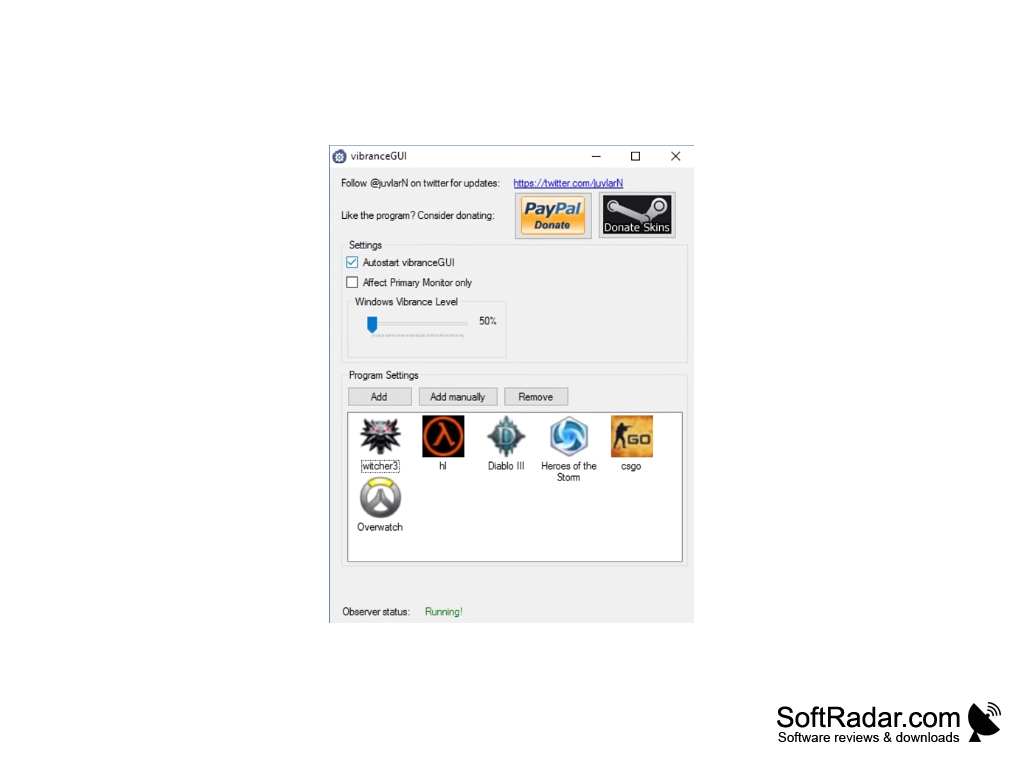
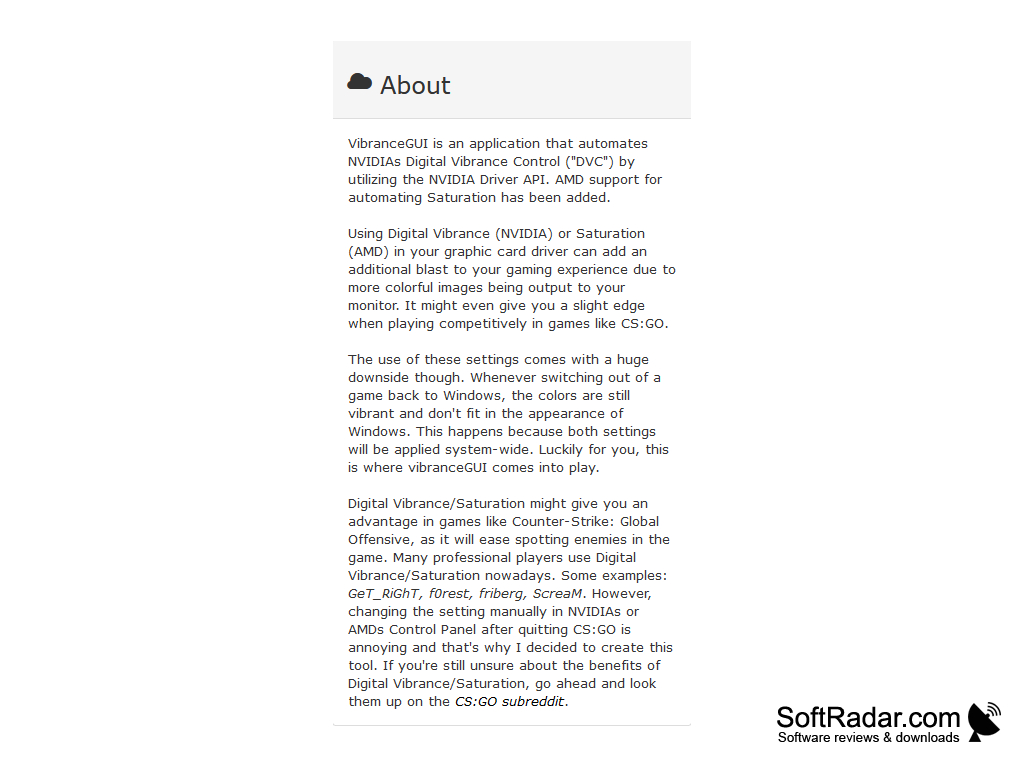
VibranceGUI is a small, free Windows utility that automates NVIDIA's Digital Vibrance Control and AMD's Saturation setting for games. Digital vibrance makes the colors on screen more saturated, and many competitive players use it in games like Counter-Strike to spot enemies against the background more easily. The catch is that the graphics driver applies this setting system-wide, so the Windows desktop also looks oversaturated after you leave the game. VibranceGUI solves this problem by raising the vibrance level only while a game you selected is in the foreground and by restoring your normal level as soon as you switch back to Windows.
Features
• Per-game vibrance levels: You set a separate in-game vibrance or saturation level for every game you add. When the game window becomes active, VibranceGUI applies that level through the native NVIDIA or AMD driver API.
VibranceGUI gives you vivid in-game colors without leaving the Windows desktop oversaturated, and without manual changes in the driver panel.
• Automatic restore: When you tab out to the desktop or close the game, the vibrance level returns to your default Windows level, so you never have to change it manually in the NVIDIA Control Panel or in the AMD settings.
• Any game or program: Since version 2.3 you can add any game or process, not only CS:GO, and the configuration of an unlimited number of games is saved.
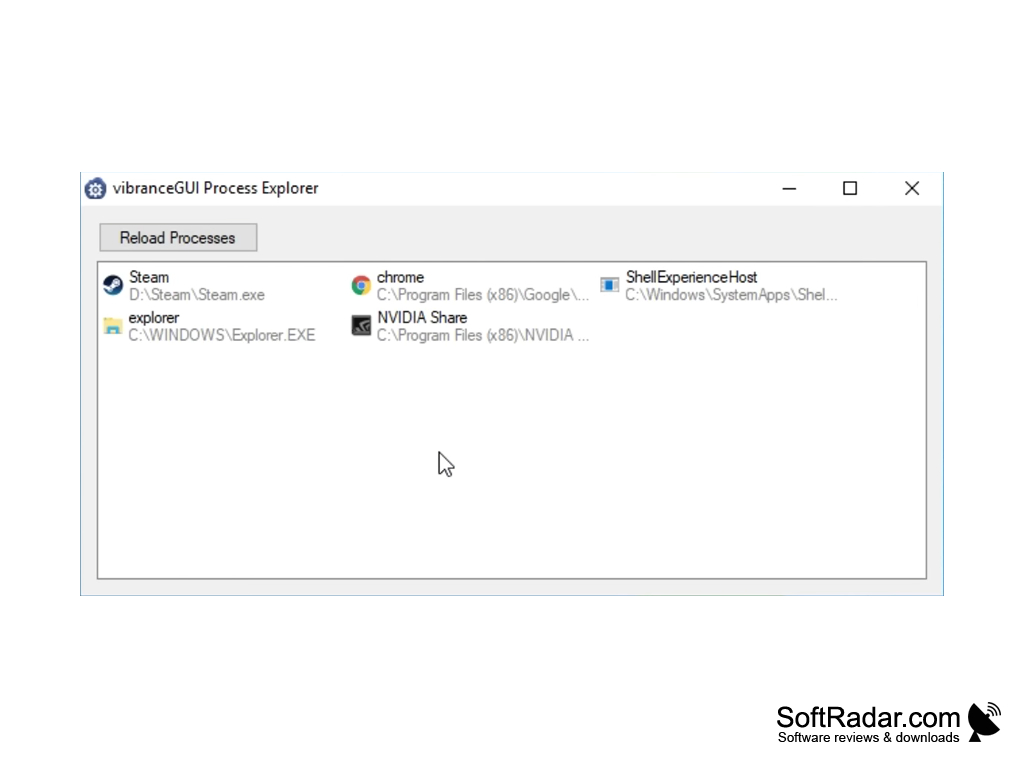
• Process Explorer: The "Add" button opens the vibranceGUI Process Explorer, which lists the running processes. Double-click a game to add it to your list, adjust its settings and press "Save". Some games, for example H1Z1, may not appear there; use Add manually for them.
• Add manually: For games that are not running at the moment, the "Add manually" button opens a file dialog where you select the .exe file of the game from its installation folder.
• Resolution switching: Optionally, VibranceGUI changes the screen resolution to your in-game resolution when you switch into a game and restores the Windows resolution afterwards, which is useful when you play in borderless windowed mode.
• Windows vibrance level: The main window has a slider for the default Windows vibrance level and an option to apply the changes to the primary monitor only.
• Tray and autostart: The program keeps running minimized in the system tray until you close it, and a checkbox makes it start automatically with Windows.
• Low resource use: Starting with version 2.0 the program is completely event-driven, so it uses very few CPU cycles and does not lower your frame rate. It does not open any connection to the internet.
• Anti-cheat safe: VibranceGUI only checks which game is running in the foreground and does not interfere with the game itself; the developer describes it as safe for VAC, ESL, ESEA, FACEIT and similar anti-cheat systems.
• Hardware support: It works with NVIDIA desktop graphics cards and with AMD cards, including AMD laptops. NVIDIA laptops are supported only if their driver offers the Digital Vibrance option, and Intel integrated graphics are not supported because Intel has no public API for it. With AMD, values above 200 can add a green tint.
• Free and portable: The program is free, its C# source code is published on GitHub, and it comes as a ZIP archive that you extract to any folder before starting it. It needs the Microsoft .NET Framework 4 and the 32-bit Visual C++ 2015 redistributable. New features appear first in beta builds on the official website.
Microsoft .NET Framework 4
Visual C++ 2015 Redistributable (x86)
PROS
Automatically changes settings when a game is in focus.
User-friendly with a simple interface.
CONS
Interface can be confusing for beginners.
Not compatible with Intel or some NVIDIA laptop GPUs.


