8085 Simulator
8085 Simulator is a free, open-source Java simulator of the Intel 8085 microprocessor that helps students learn 8085 assembly programming.
Operating system: Windows
Publisher: Jubin Mitra
Release: 8085 Simulator 1
Antivirus check: VirusTotal report
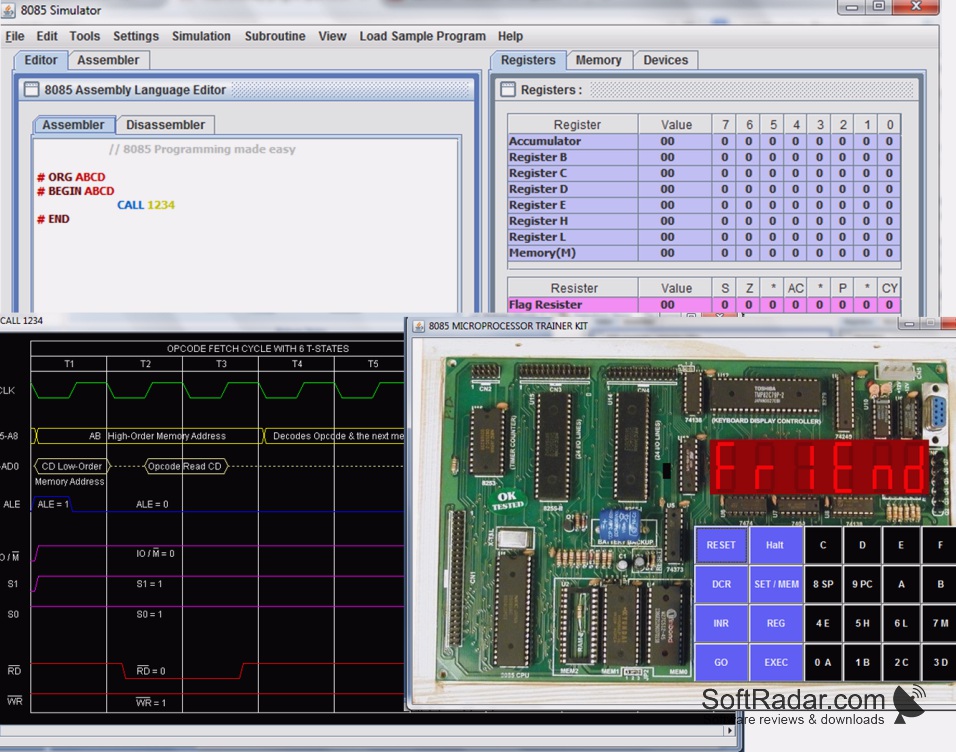
8085 Simulator is a free, open-source simulator of the Intel 8085 microprocessor and a great choice for anyone in search of a comprehensible, easy-to-use tool packed with many useful features and varied configurations. The software trains your coding and program structuring skills, as well as general knowledge of the processor architecture, without the need for real hardware. The program also gives tools such as an 8085 trainer kit simulation, which lets you work as if you were using the kit in a lab and helps you understand the hardware-related side of the processor. 8085 Simulator also features other tools, like an assembler editor, register monitoring, static and dynamic timing diagrams, sample programs, printing and more.
The simulator is written in Java, so it demands that you have Java (version 6 Update 16 or later) installed on your operating system. If you do, running the simulator is as easy as double-clicking the JAR file, really making getting into the software plain simple. Other than that, it comes with documentation, as well as source code shared under a GNU open-source license, for anyone thinking about improving the software or making it into something completely new. There are also several versions to choose from: version 2 is the current stable release, while versions 1 and 0 remain available as older editions.
8085 Simulator lets you write, assemble, debug and run 8085 assembly programs on a PC, with a virtual trainer kit instead of real lab hardware.
Features:
- Disassembler editor, which opens Intel hex files and comes with handy auto spacing, reverse tracing of the original program from the code, and syntax highlighting
- Memory editor, with 3 variations of an interface to choose from, shows the contents of a chosen memory range and lets you edit the data at any specified location; an I/O editor works the same way for ports.
- Fast crash recovery for carefree programming, without fear of losing any data due to crashes and power failures
- Plethora of useful built-in tools, all helping greatly with writing and organizing code. These include the delay subroutine generator, number conversion, as well as the interrupt service subroutine tool and more.
- Debug tools allow for step-by-step debugging of your program with forward and backward traversal. Breakpoints let you pause execution and then continue from the break-point.
In short, the 8085 Simulator provides a great utility for all learning coders, extending the possibilities of writing programs in 8085 assembly language. It is common knowledge that low-level assembly is hard to master and use effectively, but this software does indeed help with it, in an enjoyable manner.
Any Windows version that runs Java
PROS
Detailed visual representation of microprocessor operations.
Includes breakpoints, step-by-step and backward tracing.
CONS
Requires Java to be installed on the computer.
Covers only a single microprocessor model.