
LaZagne
LaZagne is an open-source command-line tool that retrieves passwords stored by many applications on a local computer.
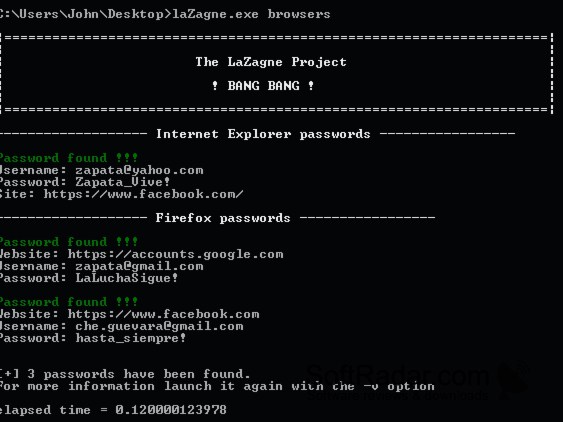
LaZagne, an open-source project with a GitHub page, is a tool that tries to find as many passwords as possible stored on your device or operating system. Each program stores its passwords in its own way (plaintext, APIs, custom algorithms, databases), and LaZagne contains separate modules for the most commonly used software. The code itself is written in Python, and a standalone release (.exe) is also published on the project page for users who do not want to install Python. The application runs on Windows, Linux and macOS, with the widest coverage on Windows. LaZagne covers browsers, sysadmin tools, familiar databases, Git and memory dumps. It also handles chats, mail clients, previously established Wi-Fi connections and many more.
The interface itself is minimal: the program runs in the Command Prompt and simply lists the passwords it found and the programs or services they belong to. We wouldn't say that's either a bad or good thing, so we'd settle to say that it simply does the job. The advantage, though, is the number of ways you can adjust how the program runs, like choosing which modules to use, changing the amount of output, or writing all the found results into text files, JSON, or both.
LaZagne finds passwords saved by browsers, mail clients, sysadmin tools and other programs on a local computer in a single scan.
Features:
- Separate modules for dozens of programs, which can be run together or one by one
- The program's light weight and minimal reliance on the CPU speed or broadly anything hardware-related
- Updates published on the GitHub page, as well as some basic help on the project setup and more
- Free and open source under the LGPL-3.0 licence, with a ready-to-run executable for Windows
Summing this all up, LaZagne is a focused tool used mainly by system administrators and security professionals to audit which credentials are stored on a computer, and it can also help people recover their own forgotten saved passwords. Because of what it does, many antivirus programs flag it as a hacking tool, and it should only be used on computers you own or are authorized to check.
Python 3 to run from source code
PROS
Open-source software offers flexibility for modifications.
Recover passwords from over 20 different applications.
CONS
Cannot recover non-locally saved passwords.
Often flagged as a hacking tool by antivirus software.


